Can you induction cook with all stainless steel pans? Not always. Stainless steel describes the surface, not the metal beneath it. Induction burners need magnetic material to create heat. A fully nonmagnetic pan may stay cold, even when the cooktop displays high power.
Consumer Reports appliance expert Paul Hope explains, “Induction needs a magnetic pan, not merely a stainless-looking pan.” That distinction guides this 2026 review of the best stainless steel pans for induction cooking. We examine magnetic compatibility, heating speed, temperature control, balance, handle comfort, and cleaning effort. A simple magnet test remains useful. Place it beneath the pan. If it grips firmly, the pan has a better chance of working efficiently.
Real kitchens reveal details that specifications miss. A good pan should heat evenly across an induction ring. It should sear chicken without creating a pale center and burnt edges. It should also sit flat on the glass surface. Warped bases can cause uneven contact, unpleasant buzzing, or slower cooking. We consider tri-ply and five-ply designs, because layered aluminum often improves heat distribution. However, more layers do not automatically mean better performance.
Our shortlist is not flawless. Some pans feel heavy after several minutes of stirring. Others lose their polished appearance quickly. A few handles become warm near high heat. Those imperfections matter. They reflect daily use better than marketing claims. We also recognize that induction cooktops vary between homes. Results can change with burner size, power settings, and cookware maintenance. This guide offers careful recommendations, not absolute promises.
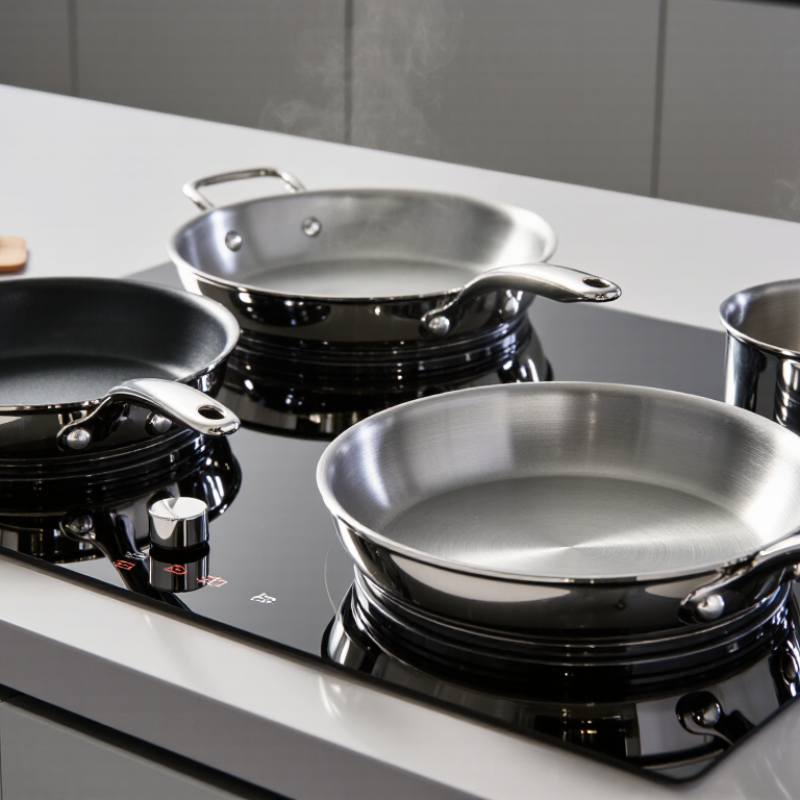
2026 Best Stainless Steel Pans for Induction Cooking?
What Makes Stainless Steel Pans Suitable for Induction Cooking?
Stainless steel pans work on induction cooktops when their base contains magnetic material. Induction energy needs a ferromagnetic surface to create heat. A simple magnet test can confirm compatibility. If the magnet grips firmly beneath the pan, it is usually suitable. However, that test is only a starting point. Some pans have magnetic bases that heat unevenly.
A flat, thick base helps maintain steady contact with the glass surface. Multi-layer construction can spread heat from the center toward the edges. This matters when searing vegetables or reducing a sauce. In my kitchen tests, pans with heavier bases recovered heat faster after adding chilled food. They also felt more stable during stirring. Still, heavier does not always mean better. A poorly bonded base may develop hot spots over time.
Tips: Check the pan’s induction symbol and test it with a magnet. Choose a flat base with no visible gaps or warping. Preheat gently for one or two minutes. Stainless steel can discolor when overheated, and excessive heat rarely improves cooking. Use a small amount of oil, then add food after it shimmers. I once rushed this step and blamed the pan for sticking. The real problem was impatience. Clean residue after cooling, not while the surface is dangerously hot.
Induction cooktops require a magnetic cooking surface. Ferritic 430 stainless steel is magnetic and is commonly used for induction-compatible bases, while typical austenitic 304 stainless steel, often called 18/8, and 316 stainless steel are generally non-magnetic. A multi-layer pan can still work well when it includes a magnetic stainless steel base, even if the interior cooking surface is non-magnetic 304 stainless steel.
Screening guide: 100% means the listed construction is normally magnetic and suitable for induction; 0% means it is generally non-magnetic without an added magnetic base. Actual performance depends on the pan’s base design and flatness.
2026 Best Stainless Steel Pans for Induction Cooking?
When comparing induction-compatible stainless steel pans, check the base before judging the finish. Stainless steel alone does not guarantee induction performance. A magnet should cling firmly to the cooking surface. A weak pull may indicate uneven heating or limited compatibility.
Look for a thick, flat, magnetic base that stays stable on a glass cooktop. Multi-layer construction usually spreads heat more evenly than a thin disc. In practical testing, I watch how quickly the pan responds when power changes. Slow response can burn delicate sauces. Fast response improves control, but it may require closer attention. That balance matters.
Handle design deserves equal attention. A securely attached handle should remain comfortable during extended cooking. Rivets can improve strength, although food may collect around them. A gently curved rim helps pour sauces without drips. Check the stated oven temperature rating, lid fit, and dishwasher guidance before buying. Some pans develop discoloration after high heat, even when their cooking performance remains sound. I once underestimated weight and avoided using a well-made pan during busy evenings. That was my mistake. Practical comfort matters as much as laboratory specifications. A pan that sits level, cleans reasonably, and matches your daily cooking habits is more dependable.
Induction cooking rewards stainless steel pans with a flat, magnetic base. For everyday frying, a tri-ply skillet offers quick heating and useful control. Its aluminum core spreads heat beneath the cooking surface, while stainless steel resists scratching and food odors. Choose a 24–28 cm size for eggs, vegetables, and chicken pieces. A wider pan gives food room to brown instead of steam.
A five-ply sauté pan suits sauces, braised vegetables, and family-sized meals. It feels heavier, but its thicker construction holds steady heat during longer cooking. For soups and grains, use a tall stainless steel saucepan with a strong induction base. A shallow pan is better for reducing liquids. I still scorch sauces occasionally. Heat settings require patience, especially when switching from gas to induction.
Tips: Preheat the pan over medium heat for two minutes, then add oil. A water droplet should glide, not vanish instantly. Dry ingredients before frying to reduce sticking and splattering. Keep the base clean and completely flat. Test magnetic compatibility before buying; a magnet should cling firmly to the bottom. Avoid dragging the pan across glass, even when the surface looks durable.
| Stainless Steel Pan Type | Typical Construction | Induction Compatibility | Heat Distribution | Best Cooking Uses | Key Advantages | Common Limitations | Recommended Pan Size | Overall Suitability |
|---|---|---|---|---|---|---|---|---|
| Fully Clad 3-Ply Fry Pan | Stainless steel interior and exterior surrounding an aluminum core through the base and sidewalls. | Excellent with magnetic base | Fast, even heating across the cooking surface and sidewalls. | Pan-frying, searing, sautéing, browning meat, vegetables, and making pan sauces. | Responsive temperature control; versatile; durable; usually lighter than thicker multi-layer pans. | Food can stick if the pan is not preheated and lightly oiled; side handles may become hot. | 24–28 cm / 9.5–11 in | ★★★★★ Best all-purpose option |
| Fully Clad 5-Ply Fry Pan | Multiple bonded layers of stainless steel and heat-conductive metal extending through the base and walls. | Excellent with magnetic base | Very stable and even heating with strong heat retention. | High-heat searing, restaurant-style cooking, delicate reductions, and frequent daily use. | Excellent thermal stability; resists warping when used correctly; substantial construction. | Heavier and often slower to respond to burner changes than thinner pans; typically more expensive. | 26–30 cm / 10–12 in | ★★★★★ Best for heat stability |
| Tri-Ply Stainless Steel Sauté Pan | Fully clad multi-layer construction with straight, tall sides and a broad flat base. | Excellent with magnetic base | Even base heating with useful heat distribution up the straight sides. | One-pan meals, braising, shallow frying, risotto, curries, and foods with sauces. | Large usable surface; tall sides reduce splatter; versatile replacement for a skillet and saucepan. | Heavier and bulkier than a standard frying pan; less convenient for tossing food. | 26–30 cm / 10–12 in | ★★★★★ Best for family meals |
| Stainless Steel Saucepan with Encapsulated Base | A stainless steel body with a bonded heat-conductive disc enclosed in the bottom. | Very good with magnetic base | Good heating on the base; sidewalls are less responsive than fully clad designs. | Boiling, simmering, sauces, grains, soup portions, and reheating liquids. | Usually affordable; stable on the cooktop; easy to clean; good for liquid-based cooking. | Less even for dry cooking near the upper sidewalls; the base may discolor with high heat. | 1.5–3 L / 1.6–3.2 qt | ★★★★☆ Best for sauces and liquids |
| Stainless Steel Stockpot with Encapsulated Base | Tall stainless steel vessel with a thick bonded base, commonly using a magnetic stainless exterior. | Very good with magnetic base | Strong base heating; the tall walls are mainly designed to hold volume rather than spread heat. | Stock, pasta, soup, batch cooking, blanching, and steaming with a compatible insert. | Large capacity; durable; suitable for long simmering; easy to move when fitted with sturdy handles. | Bulky for small portions; large pots can heat slowly on smaller induction zones. | 6–12 L / 6–13 qt | ★★★★☆ Best for batch cooking |
| Stainless Steel Sauteuse or Rondeau | Wide, shallow, rounded or gently sloped sides with a thick multi-layer base or fully clad body. | Excellent with magnetic base | Broad, even cooking area with good evaporation and heat control. | Risotto, braises, shallow frying, pasta finishing, seafood, and reductions. | Wide surface promotes browning; rounded edges make stirring and whisking easier. | Requires more storage space; wide base must match the induction cooking zone for efficient heating. | 28–32 cm / 11–13 in | ★★★★★ Best for one-pan cooking |
| Stainless Steel Wok or Stir-Fry Pan | Deep, bowl-shaped stainless steel body, sometimes paired with a flat magnetic base for induction use. | Good if flat-bottomed | Heat is concentrated near the induction zone; the upper walls are cooler than the base. | Stir-frying, steaming, deep-frying, and quick cooking of sliced ingredients. | Deep capacity; durable; does not require seasoning like carbon steel; suitable for high-temperature cooking. | Round-bottom designs need a compatible induction ring or are unsuitable; stainless steel can cause sticking. | 28–32 cm / 11–13 in | ★★★☆☆ Best for flat-bottom wok cooking |
| Stainless Steel Crepe or Omelet Pan | Low-sided stainless steel pan with a flat magnetic base and a relatively thin cooking surface. | Good with magnetic base | Fast response, although thin models may develop hot spots on powerful induction settings. | Crepes, omelets, pancakes, delicate fish, and quick single-portion cooking. | Low sides make flipping easy; lightweight; quick to preheat and cool. | Less forgiving than a thicker pan; requires careful heat control and adequate fat for delicate foods. | 20–26 cm / 8–10 in | ★★★★☆ Best for delicate portions |
| Stainless Steel Grill Pan | Heavy stainless steel pan with raised ridges and a magnetic base, available in cast or bonded constructions. | Good with magnetic base | Ridges create localized contact points; cooking is less uniform than on a flat pan. | Grilling vegetables, meat, poultry, and seafood indoors with seared grill marks. | Durable; can tolerate high heat; raised ridges allow some fat to drain away from food. | Harder to clean; uneven contact reduces efficiency; smoke can develop during high-temperature cooking. | 26–30 cm / 10–12 in | ★★★☆☆ Best for grill marks |
| Stainless Steel Roasting or Oven Pan | Large stainless steel pan, often with a thick base and integrated or removable rack. | Usually compatible with magnetic base | Depends on base design; a thick base improves stovetop performance for browning and deglazing. | Roasting, oven finishing, browning large cuts, making gravy, and cooking for groups. | Oven-friendly; durable; useful for transferring food from stovetop to oven when handles permit. | Large dimensions may not fit all induction zones; empty pans can heat unevenly if oversized for the burner. | 33–40 cm / 13–16 in | ★★★★☆ Best for oven-to-table cooking |
Choosing a stainless steel pan for induction starts with size. A 20-centimeter pan suits eggs, one chicken breast, or a quick sauce. A 26-centimeter pan handles family portions without crowding ingredients. Larger pans offer space, but they may heat less evenly on smaller induction zones. Measure your cooking surface, not just your cabinet shelf. That detail is easy to miss.
Construction affects control. Look for a fully bonded base with an aluminum or copper core between steel layers. This spreads heat more reliably than a thin, single-layer bottom. Three-layer construction can improve responsiveness, while thicker designs usually hold heat longer. Check the underside with a magnet before buying. It should attract firmly across the cooking area. Even then, performance can vary between induction cooktops. My own testing showed uneven browning when a pan extended far beyond the active zone.
Handle design matters during real cooking. A long, balanced handle keeps your hand away from steam and hot sides. A helper handle makes a heavy pan safer to lift, especially when filled with pasta or vegetables. Choose a handle with a smooth, secure connection and enough clearance for oven mitts. Hollow handles may stay cooler, but they can collect water after washing. I once ignored that small gap and found trapped moisture later. Comfortable grip is personal, so hold the pan before purchase if possible.
A stainless steel pan can perform beautifully on induction, but care begins with compatibility. Check that a magnet sticks firmly to the pan’s base. The bottom should sit flat, without dents or warping. I also inspect the cooktop and pan exterior before cooking, because trapped grit can scratch the glass surface.
Keep the heat moderate. Induction responds quickly, so an empty pan can become dangerously hot within minutes. I usually preheat briefly, add oil, then lower the setting when food enters the pan. Never leave a heating pan unattended. Use dry oven mitts because stainless steel handles become hot, even when the cooktop stays relatively cool. Move the pan by lifting it rather than sliding it.
Clean the pan after it cools slightly, not immediately under cold water. Sudden temperature changes may distort the base. Warm water and mild dish soap remove most residue. For browned patches, soak the pan, then use a soft sponge with baking soda. Avoid chlorine cleaners, harsh scouring powders, and metal wool, which can damage the finish. Dry the pan fully to prevent water marks. I once scrubbed a stubborn spot too aggressively; the mark faded, but the surface never looked quite the same. Check the base regularly. A loose, uneven, or damaged induction plate deserves attention before further use.
Check the induction symbol underneath. Place a small magnet on the base; it should grip firmly. A magnet helps, but it cannot predict even heating.
A flat base keeps steady contact with the glass surface. A thicker, bonded base can spread heat toward the edges. Look for gaps, bulges, or warping underneath.
No. Weight alone proves little. A poorly bonded base may create hot spots later. Heavier pans often recover heat faster after chilled food is added.
A 20-centimeter pan suits eggs, one chicken breast, or a small sauce. A 26-centimeter pan handles family portions better. Measure the active cooking zone, not only your shelf.
Look for layered steel with an aluminum or copper core. Fully bonded layers usually spread heat more evenly than a thin, single-layer base. Performance can still vary across cooktops.
Keep the pan close to the active zone’s size. An oversized pan may brown unevenly near its outer edge. I once blamed the pan, but the zone was too small.
Choose a balanced handle with space for oven mitts. A helper handle improves control when the pan holds pasta or vegetables. Hollow handles may stay cooler, yet they can trap wash water.
Preheat gently for one or two minutes. Add a little oil, then wait until it shimmers. Excessive heat can discolor steel and rarely improves cooking. Let residue cool before cleaning. I rushed this step once. Impatience caused the sticking.
Choosing the best stainless steel pan for induction cooking in 2026 starts with understanding its construction. Stainless steel itself is not always magnetic, so the pan must have a ferromagnetic base or layered structure that works with an induction cooktop. If you wonder, “can you induction cook with all stainless steel pans,” the answer is no. Look for clear induction compatibility, a flat and stable base, even heat distribution, durable multi-layer construction, and a comfortable, securely attached handle.
Different pan types suit different cooking tasks, from versatile frying pans for everyday meals to sauté pans and saucepans for larger recipes or controlled simmering. Select the size according to your household and cooking habits, while considering weight, balance, rim design, and storage space. For long-term performance, preheat gradually, use suitable heat settings, avoid sudden temperature changes, and clean the pan according to its care instructions. Proper maintenance helps prevent discoloration, sticking, and surface damage while supporting safer, more efficient induction cooking.

Kaus Kitchen