Choosing stainless steel cookware can feel simple until product labels start competing for attention. Three-ply, five-ply, clad, disk-bottom: each describes a construction choice, not a guarantee of better cooking. This guide explains how to choose the right ply stainless steel cookware by looking beyond the number of layers. It focuses on what those layers do, how evenly a pan heats, and whether its design suits your kitchen.
In many clad pans, an aluminum or copper core helps spread heat between stainless steel layers. That can matter when you’re simmering a delicate sauce or browning food across a wide skillet. More layers aren’t automatically better. A well-made three-ply pan may suit everyday meals, while heavier cookware can feel steadier but take longer to heat. Details vary by brand, so check the construction description rather than relying on a product name alone.
The sections ahead compare common ply counts, core materials, weight, handle comfort, induction compatibility, and oven limits. Look for clear specifications and care instructions, especially if you plan to use high heat or move pans from stovetop to oven. A useful test is whether the pan feels balanced when lifted and has a cooking surface that fits your burner. Small details count. Product pages can be confusing, and I wouldn’t treat a higher price as proof of better performance. The right choice depends on how you cook, how often you clean, and what feels manageable in your hands.
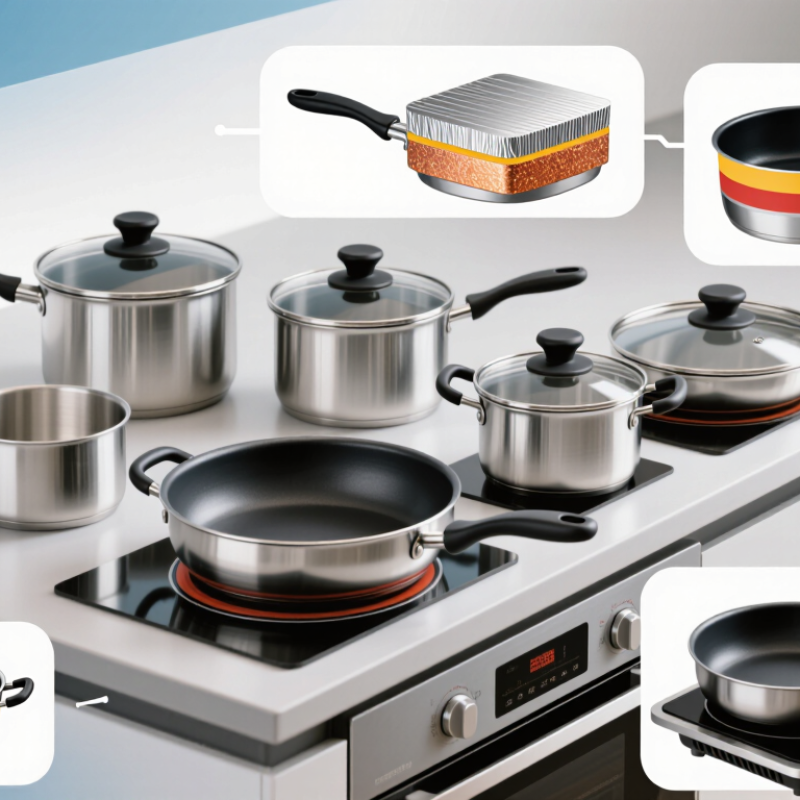
“Ply” means the number of bonded metal layers in a pan. A common three-ply construction places an aluminum core between stainless steel layers. The stainless surfaces provide a durable cooking surface, while the core helps spread heat. More layers do not automatically mean better cooking. The metals, thickness, and bonding all matter.
The difference in heat transfer is substantial. Euro Inox’s technical-property tables report thermal conductivity of about 15 W/m·K for 304 stainless steel at 20°C. ASM International’s materials data place commercially pure aluminum near 237 W/m·K. These figures explain why many layered pans use aluminum inside. They are reference values, not a guarantee of pan performance; alloy and temperature affect results. That matters.
Look at where the layers run. Full-clad cookware carries its layered construction up the sides, which can help when simmering sauce. Some pans have a layered base but thinner, single-material walls. Check the product specification, not just the “five-ply” label. A thicker stack sounds better, but that shortcut can mislead. In a kitchen, a pan that heats evenly and sits flat may be more useful than one with the highest layer count. Small detail. Check the rim or cutaway illustration for visible layers, and consider weight if you often lift a full pan.
Three-ply cookware usually sandwiches an aluminum core between stainless steel layers. The core spreads heat more evenly than a single layer of steel, while the cooking surface resists reacting with food. For everyday tasks, such as browning onions or simmering soup, this construction is often responsive without feeling too heavy. A practical middle ground.
Five-ply designs add layers, often combining stainless steel with aluminum or other conductive metals. They may distribute heat more steadily across the base and sides, which helps when reducing a sauce in a wide pot. But “five-ply” does not guarantee better cooking: layer materials, thickness, and bonding matter more than the number alone. Check the construction details.
Seven-ply cookware can feel substantial and retain heat well, useful for steady searing or long braises. That mass can also mean slower temperature changes, heavier pans, and longer warm-up times. More layers are not automatically an upgrade. Even experienced cooks can overvalue the ply count and overlook handle comfort or pan balance. Compare the same pan size in person if possible; a small difference in weight becomes obvious when lifting a full pot. A specification sheet rarely tells the whole story.
When comparing ply stainless steel cookware, look beyond the number printed on the label. “Ply” describes bonded layers, often stainless steel around an aluminum core. Aluminum spreads heat quickly, while stainless steel provides a durable cooking surface. Copper may appear in some constructions, but it does not automatically make a pan more suitable for everyday cooking.
Check whether the layers run across the whole pan or only through its base. Fully clad sides can heat more evenly when simmering sauces, while a thick, bonded base may suit routine frying. Feel the pan, too. A very light body can develop hot spots; an overly heavy one may be awkward to lift when full. More layers are not always better. Construction quality matters more than a higher ply count.
Look for smooth seams, firmly attached handles, and a flat base that sits steadily on your cooktop. For induction, the exterior must be magnetic; a simple magnet test can help. Rivets should feel secure, though food can collect around them. There is no perfect pan. A detail I might still overlook is handle comfort until the pan is hot and loaded, so consider how it feels in your hand.
Match cookware to the meals you actually make, not an idealized kitchen routine. If you often sear chicken or brown mushrooms, choose a sturdy frying pan with a flat base and enough room to prevent crowding. For oatmeal, sauces, or reheating soup, a smaller saucepan may earn more use than a large stockpot. That matters. Multi-ply stainless cookware typically combines stainless-steel surfaces with a heat-spreading metal core. The number of layers alone does not tell you how evenly a pan will heat; construction and thickness matter too.
Consider your cooktop and how you handle pans. Check that the base is compatible with your stove, especially if you cook on induction. A heavy pan can feel stable and hold heat well, but it may be awkward to lift when full. Not always a good trade. Riveted handles, oven-safe limits, and dishwasher guidance are worth checking against your habits. If you cook for one or two people, a few versatile pieces may be easier to store and maintain than a large set. If you regularly cook several dishes at once, matching pots and pans in useful sizes can save time. I would still leave room to revise the choice: cooking needs change, and a rarely used specialty pan can take up valuable shelf space.
| Cooking need | Useful cookware | Construction to consider | Why it may suit the task | Practical checks |
|---|---|---|---|---|
| Searing meat and browning vegetables | Frying pan or skillet | Clad stainless steel with an aluminum core; 3-ply is a common construction | An aluminum core helps spread heat, while the stainless cooking surface supports browning and is nonreactive with ordinary foods. | Choose a flat, stable base and a handle that feels secure. Preheat, then add oil to help reduce sticking. |
| Sauces, grains, and everyday cooking | Saucepan with a fitted lid | Fully clad construction or a thick, bonded base | Even heat distribution can help with simmering and reduce localized hot spots. Stainless steel is suitable for acidic ingredients such as tomato sauce. | Match capacity to typical portions; a smaller pan is often easier to handle for one or two servings. |
| Soups, pasta, and batch cooking | Stockpot or large covered pot | A sturdy bonded base; full cladding is useful when cooking thicker mixtures | A larger volume accommodates liquid and ingredients, while a stable base supports even heating on the cooktop. | Check the filled weight, lid fit, and handle design. A large pot can be heavy when full. |
| Induction cooking | Any pan labeled compatible with the cooktop | Magnetic stainless steel in the base or exterior layer | Induction requires a magnetic cookware base; stainless steel cookware is not automatically induction-compatible. | Check the manufacturer’s compatibility information or test the base with a magnet. A flat base helps maintain contact. |
| Frequent oven-to-stovetop cooking | Oven-safe skillet or saucepan | Clad stainless steel; construction alone does not establish the oven limit | Many stainless steel pans can move between cooktop and oven, but handles, lids, and other components determine the safe temperature. | Verify the stated oven-safe temperature for the complete pan, including its lid and handle. |
| Low-maintenance, long-term use | A small, versatile set or individual essential pieces | 3-ply or other bonded construction from a reputable cookware specification | Stainless steel is durable and does not require a seasoning layer. More plies do not automatically mean better cooking performance. | Prioritize useful sizes, comfortable handles, and clear care instructions over ply count alone. |
| Cooking delicate eggs or foods prone to sticking | Nonstick pan, or stainless steel with careful technique | Ply construction improves heat distribution but does not make stainless steel nonstick | A coated pan can release delicate foods more easily; stainless steel can work well when properly preheated and used with sufficient fat. | Choose based on cooking habits and follow the care guidance for any coated surface. |
Quick guide: Match pan shape and size to the dish, confirm cooktop and oven compatibility, and compare construction details rather than choosing by ply count alone. “3-ply” and “5-ply” describe layer counts, but materials, layer arrangement, pan thickness, and design also affect performance.
A good multi-ply stainless steel pan should feel solid, but not awkwardly heavy. Check that the base sits flat on a cool, level surface. Look for smooth, even seams and firmly attached handles. Exposed layers at the rim can show the construction, though appearance alone cannot prove how evenly the pan heats. I still find this easy to misjudge.
Compatibility depends on both the pan and your cooktop. For induction, a magnet should cling firmly to the cooking surface; this is a useful check, not a guarantee of overall quality. Gas and electric users should check the pan’s stated compatibility, then match its base size to the burner. A narrow burner under a wide pan may leave the edges cooler. Small detail, real difference.
Care affects performance over time. Heat the pan gradually, and avoid leaving it empty over high heat. For less sticking, preheat before adding oil and food; adjust the heat if oil smokes. Let the pan cool before washing, since sudden temperature changes can warp some cookware. Warm water and dish soap handle most residue. Stubborn spots may need a brief soak. Follow the care instructions, and inspect handles and seams occasionally. A pan can look fine and still need a closer check.
Values are approximate thermal conductivity at room temperature, measured in watts per meter-kelvin (W/m·K). Aluminum or copper cores conduct heat more readily than stainless steel, which is why they are commonly used in clad cookware.
How to assess cookware: Check the manufacturer’s construction details and look for a securely bonded, even core. For induction, confirm the cookware has a magnetic base; a magnet that sticks to the bottom is a useful basic check. Follow the maker’s care instructions, avoid sudden temperature changes, and do not use chlorine bleach on stainless steel.
It usually has an aluminum core between stainless steel layers. This core spreads heat more evenly than single-layer steel. A useful middle ground.
No. Layer materials, thickness, and bonding matter more than the ply count alone. Five layers may help distribute heat steadily, especially when reducing sauce in a wide pot.
It can retain heat well for searing or long braises. But it may warm slowly and feel heavy when full. More layers are not automatically better.
Set it on a cool, level surface and check that the base sits flat. Look for smooth seams and firmly attached handles. I still find weight easy to misjudge.
A magnet should cling firmly to the cooking surface. That is a useful check, not a guarantee of overall quality. Check the pan’s stated compatibility too.
Match the pan’s base to the burner. A narrow burner under a wide pan may leave the edges cooler. Small detail, real difference.
Heat it gradually, then preheat before adding oil and food. Lower the heat if the oil smokes. Warm water and dish soap handle most residue.
Let the pan cool before washing; sudden temperature changes may warp some cookware. Soak stubborn spots briefly. Check the handles and seams now and then. A closer look helps.
Choosing cookware starts with understanding what “ply” means: the number and arrangement of bonded metal layers that influence heat distribution, responsiveness, durability, and cooking performance. Comparing common constructions—from simpler layered bases to fully clad cookware—helps clarify which design suits your budget and everyday habits. Material choices also matter: stainless steel provides a durable cooking surface, while the metals in the core affect how quickly and evenly a pan heats. Consider handle comfort, construction quality, and whether each piece works with your cooktop.
To decide how to choose the right ply stainless steel cookware, match its performance to the meals you prepare, the heat control you prefer, and how often you cook. Check for sturdy, even construction and compatibility with your cooking surface, then follow practical care instructions to help preserve the cookware. The best choice balances reliable heating, ease of use, and long-term durability without paying for features you are unlikely to need.

Kaus Kitchen